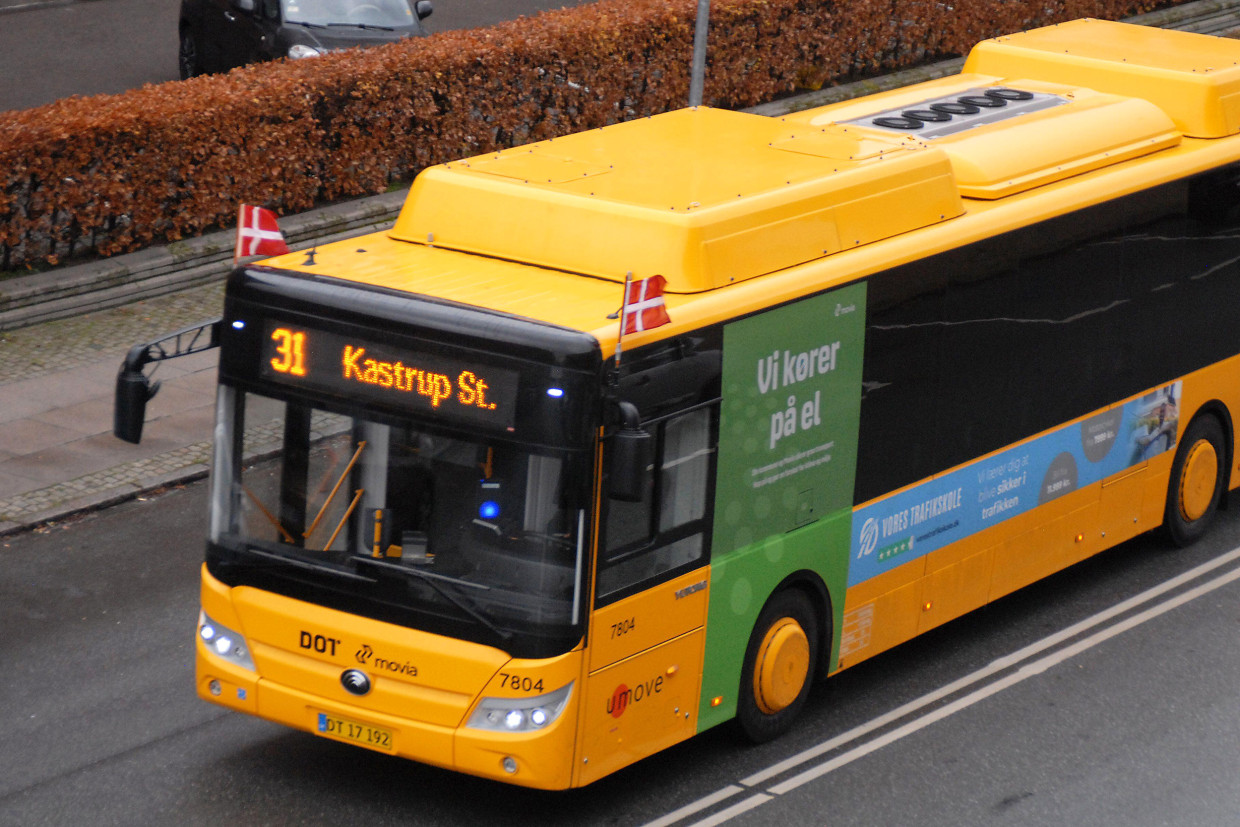

Growing concerns about technological dependence are reshaping Europe’s approach to public transportation and cybersecurity. What was once a quiet and efficient sector in Scandinavia is now at the center of a heated debate about national security and digital sovereignty.
Rising alarms over Chinese-built buses
Public transportation operators in Denmark and Norway are confronting a potential security flaw in their electric bus fleets, specifically in vehicles produced by Yutong, the world’s largest bus manufacturer based in Zhengzhou, China. The issue stems from the buses’ ability to receive remote software updates and diagnostic checks — a feature that, while technologically advanced, also raises concerns that the vehicles could be immobilized or manipulated from afar.
Movia, Denmark’s leading public transit agency, has acknowledged that this over-the-air functionality could allow a third party — either the manufacturer or a hacker — to remotely disable a bus. Jeppe Gaard, Movia’s chief operating officer, explained that the problem is not unique to Chinese manufacturers but is a broader challenge tied to the increasing digitalization of modern vehicles. Electric cars and buses alike, he noted, rely heavily on online systems that can, in principle, be accessed and deactivated remotely.
Since 2019, Movia has incorporated more than 260 Yutong buses into its fleet serving Copenhagen and eastern Denmark. Similar concerns were echoed in Norway, where Ruter, a major public transportation provider, conducted its own investigation. The company carried out controlled tests on both Yutong and Dutch-made VDL buses in secure, underground facilities. The findings showed that while the Dutch models lacked remote update capabilities, Yutong maintained direct digital access to its vehicles for software updates and diagnostics — meaning that, at least theoretically, the buses could be rendered inoperable remotely, even though they could not be remotely driven.
China’s response and data protection assurances
Yutong has responded to these claims by affirming its compliance with international regulations and emphasizing its commitment to data privacy and cybersecurity. The company stated that all vehicle data within the European Union is securely housed in an Amazon Web Services data center located in Frankfurt, Germany. Yutong further assured that all stored information is encrypted, protected by strict access controls, and inaccessible without explicit customer authorization.
Despite these assurances, European officials and transportation firms maintain a wary stance. This event has amplified conversations regarding Europe’s increasing reliance on Chinese technology—a connection marked by reciprocal economic advantages yet overshadowed by profound geopolitical suspicion. Beijing’s purported participation in cyber espionage, intellectual property theft, and surveillance operations has prompted numerous European leaders to reevaluate the enduring consequences of their dependence on Chinese providers for essential infrastructure.
A wider European predicament
The examination of Yutong’s buses represents just one recent chapter in Europe’s intricate technological ties with China. Throughout the continent, political leaders are striving to achieve a careful equilibrium: harnessing China’s sophisticated production prowess while simultaneously safeguarding national interests. Recent occurrences, such as the Netherlands’ move to take over the Chinese-owned chip manufacturer Nexperia, have intensified worries that Europe’s automotive and tech industries might encounter significant disturbances should diplomatic or commercial disputes arise.
Many administrations have already implemented measures to restrict susceptibility to potential weaknesses. Several European countries, emulating the United States, have purged Huawei and ZTE apparatus from their 5G infrastructure, citing espionage and data manipulation hazards. Currently, focus has shifted to the rapidly expanding sector of Chinese electric vehicles. As per JATO Dynamics, Chinese EVs saw their market penetration in Europe double in early 2025, surpassing 5% — a statistic that underscores both consumer demand and regulatory apprehension.
China, for its part, has dismissed Western fears as unfounded and politically motivated. Earlier this year, a spokesperson for China’s Foreign Ministry criticized U.S. restrictions on Chinese automotive technology, arguing that such measures “overstretch the concept of national security.” Chinese officials maintain that their companies operate transparently and pose no threat to foreign nations.
Western intelligence concerns
Security experts across Europe, however, remain skeptical. Former MI6 chief Richard Dearlove warned that Western governments are facing a challenge similar to the one posed by Huawei during the 5G rollout. In his view, the increasing prevalence of connected vehicles built by Chinese manufacturers could create new vulnerabilities. He suggested that, in a worst-case scenario, China could theoretically disable fleets of electric vehicles in major cities — a scenario that could disrupt transportation networks during a crisis.
Still, some cybersecurity experts contend that such a situation, though technically possible, is improbable. Ken Munro, the creator of the Anglo-American company Pen Test Partners, pointed out that any vehicle connected to the internet—regardless of whether it’s manufactured by a Western or Chinese firm—inherently carries dangers of distant manipulation. Even prominent names such as Tesla, he clarified, rely on software connections that could be compromised under particular circumstances.
In response to these concerns, Ruter has implemented a series of protective measures, including enhanced cybersecurity protocols, firewalls, and stricter oversight of future vehicle acquisitions. The company is also working with national authorities to establish clearer cybersecurity standards for public transport systems. However, experts remain divided on whether such precautions are sufficient. Munro cautioned that the only foolproof method to eliminate the risk would be to completely remove online connectivity from vehicles — a move that would also hinder the ability to perform critical updates and maintenance remotely.
The intersection of innovation and vulnerability
The discussion emerging in Scandinavia highlights a wider contradiction of the digital era: the very technologies that facilitate efficiency and progress can simultaneously expose systems to novel types of hazards. As urban centers endeavor to update public transit and decrease carbon output via electrification, they are also compelled to confront issues concerning technological autonomy, information confidentiality, and national defense.
Europe’s reliance on Chinese-made components and software extends far beyond public transport. From communication networks to renewable energy infrastructure, the continent’s modernization is deeply intertwined with China’s industrial ecosystem. As global tensions rise, the challenge for European nations will be to secure their technological independence without stalling their progress toward sustainability and innovation.
The debate over Yutong’s bus fleet highlights a critical point: cybersecurity is now as vital as sustainable power in defining the trajectory of city transportation. This challenge extends beyond a single nation or producer, marking a pivotal moment for the subsequent stage of Europe’s digital evolution.
In conclusion, as Ken Munro so aptly put it, the core of the discussion centers on a single concept—trust. And in our progressively intertwined global landscape, trust could very well emerge as the most precious and delicate commodity.